How to tell your face shape by hand
Your face shape decides which haircut, frames, hat and earrings flatter you, so it pays to get it right. You can work it out yourself in front of a bathroom mirror with a soft tape measure, a washable marker and ten quiet minutes.
This guide walks you through the four measurements, shows how to read the six shapes from them, and settles the three pairs of shapes people confuse most. It also explains why a selfie can give you the wrong answer, and what to do when you land between two shapes.
What you need, and how to stand
You need a mirror you can stand square to, a soft tape measure (the cloth kind used for sewing), a dry-erase marker or a bar of soap to draw on the glass, and a hair tie or a few clips. Pull your hair off your forehead, cheeks and jaw, and take off your glasses and any long earrings.
Stand about an arm's length from the mirror in even light from the front. Keep your face relaxed, your mouth closed and your head level, since a smile widens the cheeks and a tilt changes every width. Close one eye while you mark: with both open, each eye sees your reflection in a slightly different place on the glass, and the marks drift.
The four measurements, one by one
Mark each point on the glass where you see it in your reflection, then measure between the marks with the tape laid flat on the mirror. The marks come out at half your real size, because a flat mirror shows you at half scale on its surface, but only the proportions between the four numbers decide the shape. Measuring on the glass also keeps every width a straight line, which a tape wrapped around your cheeks cannot do.
Forehead width: find the widest part of your forehead, usually about halfway between your eyebrows and your hairline. Mark the spot on each side where the skin of the forehead meets the hair at the temple.
Cheekbone width: press your fingertips along your cheeks just below the outer corner of each eye until you feel the highest, most outward point of the bone. Mark both points. On most faces this is the widest line.
Jaw width: slide a finger back along your jawline from the chin until the bone turns upward toward the ear, below the earlobe. Mark that corner on both sides.
Face length: mark the middle of your hairline and the bottom of your chin. If your hairline has moved back or always sat high, mark the point where your forehead starts to curve back over your head.
Write the four numbers down. Then trace the outline itself, from one temple mark down past the cheekbone and jaw corner, around the chin and up the other side. Step back and look at it as if it were someone else's: the outline alone often shows whether your jaw is rounded or squared off.
Reading the six shapes from your numbers
Start with the largest of your three widths and set your face length against it. If the two are close, your face is short for its width; if the length is a little greater, it is of medium length; if it is clearly greater, the face is long. Most faces measure somewhat longer than they are wide, so the shapes are told apart by comparing your numbers with each other, not by an exact ratio. Then compare the three widths, and check the jaw corner on your tracing.
Oval: the cheekbones are widest, the forehead is a little wider than the jaw, and the face is a little longer than it is wide. The jaw curves into the chin without a sharp corner.
Round: the cheekbones are widest again, but the length is close to the width. The cheeks are full and the jawline runs in one smooth curve.
Square: forehead, cheekbones and jaw measure nearly the same, and the length is close to the width. The jaw turns a clear corner below each ear and runs fairly straight to the chin.
Oblong: the three widths are nearly equal here too, but the face runs clearly longer than an oval, with long, straight sides from temple to jaw.
Heart: the forehead is the widest line or level with the cheekbones, and the jaw is clearly narrower, ending in a small or pointed chin.
Diamond: the cheekbones stand out as the one clear widest line, while the forehead and the jaw are both narrower and close to each other. The chin is often narrow.
Once you have a name for it, the guide to accessories for your face shape shows what each shape gains from hairstyles, glasses, hats and earrings.
Round or square?
These two share their numbers: widths close together and a face about as long as it is wide. The difference is the jaw. If the bone turns a clear corner below the ear, you are square; if it sweeps up toward the ear in one curve, you are round. Full cheeks point to round as well, but cheeks change with weight, while the jaw corner stays.
Getting this pair wrong flips the advice. Round faces want lines and corners to add definition, square faces want curves to take the edge off the jaw, so the frames and earrings that help one shape work against the other. You can watch the flip happen in the glasses try-on.
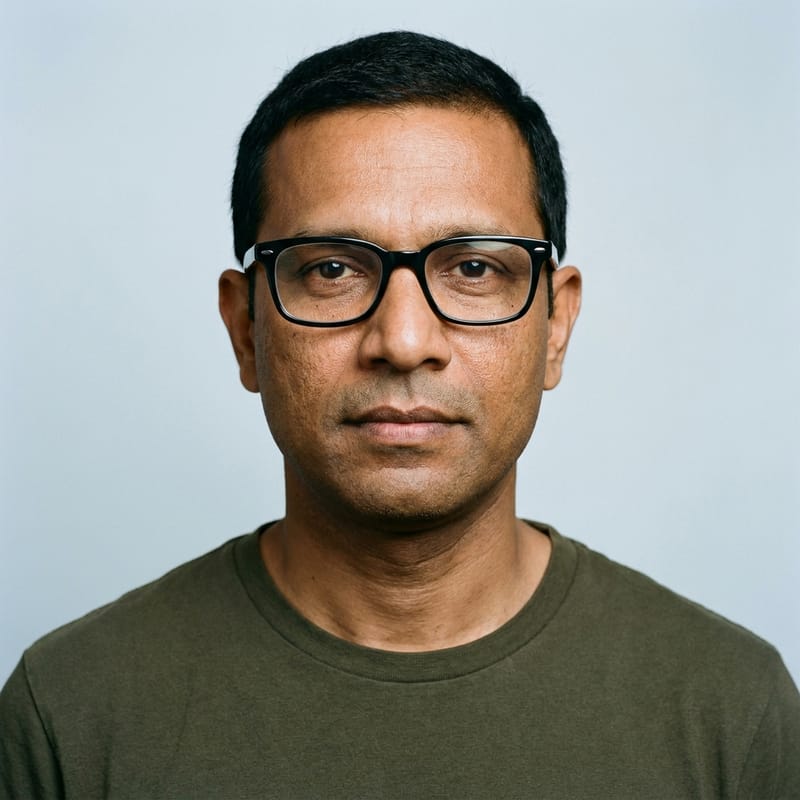
Rectangle glasses
A straight top bar and squared lenses give a round face the corners it lacks. On a square face the same frame repeats the jaw and makes the whole face look boxier.
Try it on me →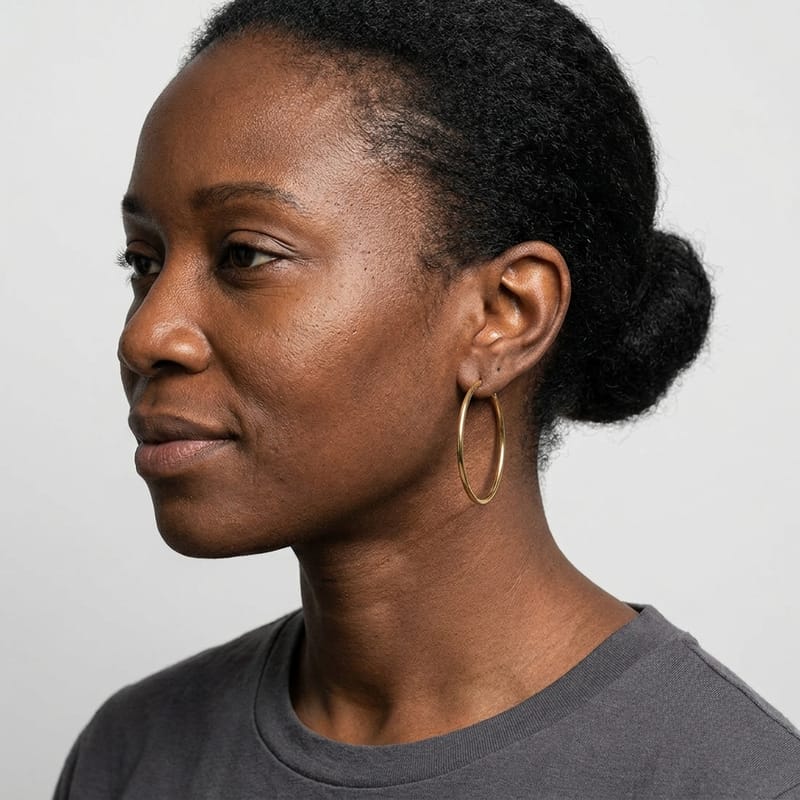
Gold hoops
Large hoops swing in a curve beside the jaw, which softens a square jawline. On a round face the same circle hangs next to the fullest part of the cheeks and adds width there instead.
Try it on me →Oval or oblong?
Both shapes are longer than they are wide, so people with an oblong face often call it oval. Check the length first: an oval face is a little longer than it is wide, while an oblong face is clearly longer, with length to spare even against its widest line. Then check the sides. An oval narrows gently from the cheekbones to a rounded jaw; an oblong face keeps all three widths nearly level, so its tracing looks like a long rectangle with soft corners.
The answer decides whether a style may add height. An oval face carries volume on top with ease; an oblong face looks longer still under it and does better with width at the sides. If you are unsure, compare both directions in the hairstyle try-on or the hat try-on.
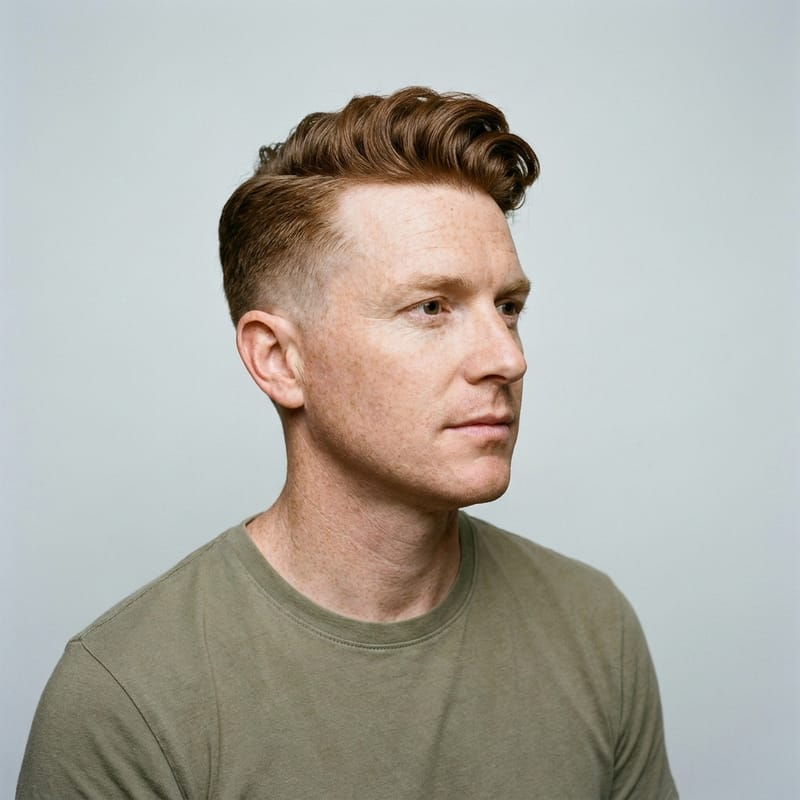
Quiff
Hair swept up and back at the front adds height above the forehead. That suits an oval face but stretches an oblong one further, so a quiff is a fair test of which of the two you have.
Try it on me →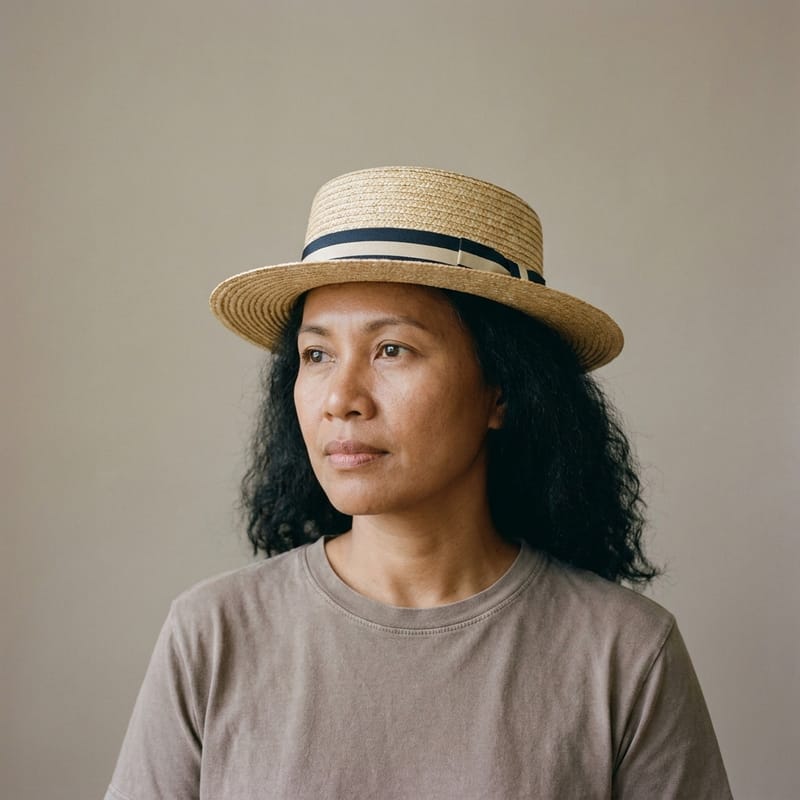
Boater
A low, flat crown and a straight brim add width across the head without adding height. It is one of the easiest hats for an oblong face, and an oval face wears it just as well.
Try it on me →Heart or diamond?
Both shapes taper to a narrow chin, so look at the top of the face. On a heart, the forehead is as wide as the cheekbones or wider, and the outline narrows in one line to the chin. On a diamond, the forehead narrows too, so the cheekbones stick out on each side and the outline tapers twice, up and down.
The top decides the frames: a heart face wants glasses that stay light along the top, a diamond face wants them to add width at the brow. Earrings are the easy part, since both shapes gain from pieces that widen toward the bottom, and the earring try-on has several.

Browline glasses
A heavy upper rim along the brow over a light lower half widens the top of the face. A diamond face needs exactly that and a heart face does not, so these frames tell the two shapes apart quickly.
Try it on me →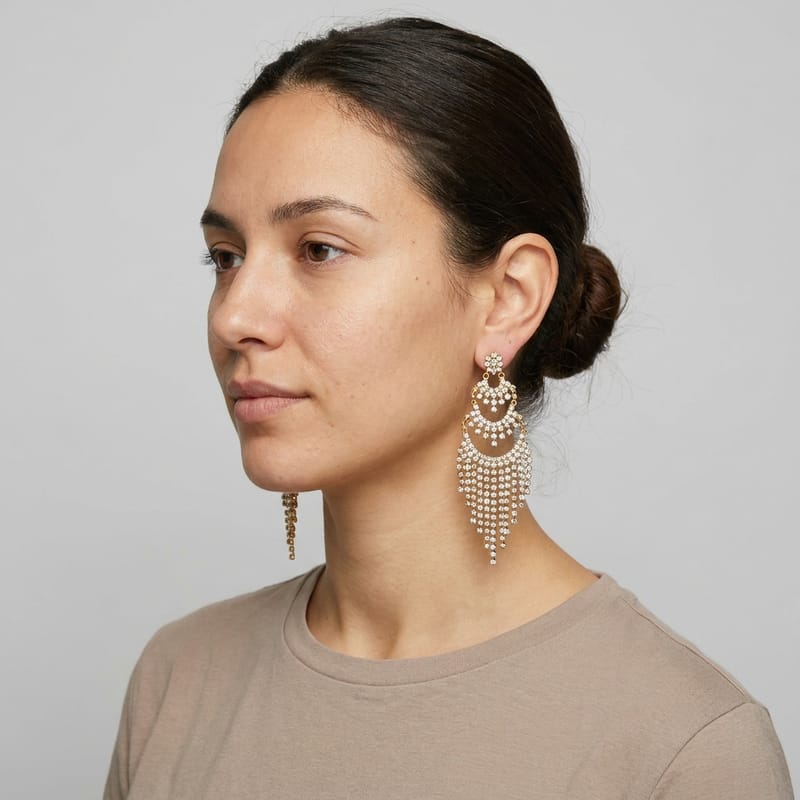
Chandelier earrings
Tiered rows that fan out below the earlobe put width beside a narrow chin. They suit a heart and a diamond face alike, which makes them a safe pick while you are still deciding between the two.
Try it on me →Why photos give the wrong answer
A phone's front camera has a wide lens, and at arm's length it sits close enough to stretch the middle of your face. Your nose and the center of your face come out larger while the sides and ears fall back, so a round face can pass for oval. For a photo you want to measure from, have someone take it from a few steps away with the phone's zoom, the lens at the height of your eyes.
Tilt changes the result as well. Chin down, the forehead grows and the jaw shrinks, which pushes any face toward heart. Chin up, the jaw widens and the forehead shortens, which pushes it toward square or round. A head turned even slightly makes one cheek wider than the other.
Hair is the third trap. Bangs hide where the forehead starts and how wide it is, and long hair along the cheeks makes the face look narrower on camera. Pull it all back, the same as for the mirror. The face shape detector needs that kind of photo too: front-on, head level, hair back.
When you land between two shapes
Few faces match one description exactly. A long face with a softly rounded jaw sits between oval and oblong; a short face with a firm jaw corner and full cheeks sits between round and square. That is normal, and it does not mean you measured wrong.
Take the shape your numbers lean toward as your main shape and the other as a tie-breaker. Where their advice agrees, follow it; where it conflicts, go with the feature people notice first, the length or the jaw. The balance rule behind every pick shows why neighboring shapes so often share their advice.
If two careful rounds of measuring still leave you split, the detector gives a second opinion from a single selfie and tells you which of the six your proportions sit nearest.
FAQ
Do I need a tape measure to find my face shape?
No. A ruler laid flat on the mirror works the same way, and the traced outline on its own often shows the shape. The tape just makes close calls easier.
Should I measure in inches or centimeters?
Either, as long as you use one unit for all four numbers. Only the proportions between them decide the shape.
Can my face shape change over time?
Your bone structure stays much the same in adult life, but gaining or losing weight changes how full the cheeks and jaw are. That can move your reading toward a neighboring shape.
How do I find my face shape if I have a beard?
Press through the beard to the jawbone and mark the bone, not the hair. A full beard does change how wide your jaw looks to others, so note both widths.
Is an oblong face the same as a long or rectangular face?
Yes, these are names for one shape: longer than an oval, with nearly equal widths at the forehead, cheekbones and jaw. Some stylists keep "rectangular" for an oblong face with a squared jaw.
Why does my face look like a different shape in every photo?
Camera distance, head tilt and hair all change the proportions a photo shows. A phone held close makes the face look narrower, and a lowered chin makes the forehead look wider.
Where do I measure from if my hairline is receding?
From the point where your forehead starts to curve back toward the crown. The shape comes from your bones, not from where the hair happens to start.
Is there a quicker way than measuring?
The face shape detector reads the same widths and length from one front-facing selfie and names your shape in seconds, free.